
Wire mesh measurement guide
How to Measure Stainless Steel Wire Mesh
To measure stainless steel wire mesh, count the openings across 25.4 mm, measure wire diameter at several points, then calculate the nominal clear opening: 25.4 ÷ mesh count − wire diameter (mm). Check both weave directions before ordering or accepting a roll.
See the measurement steps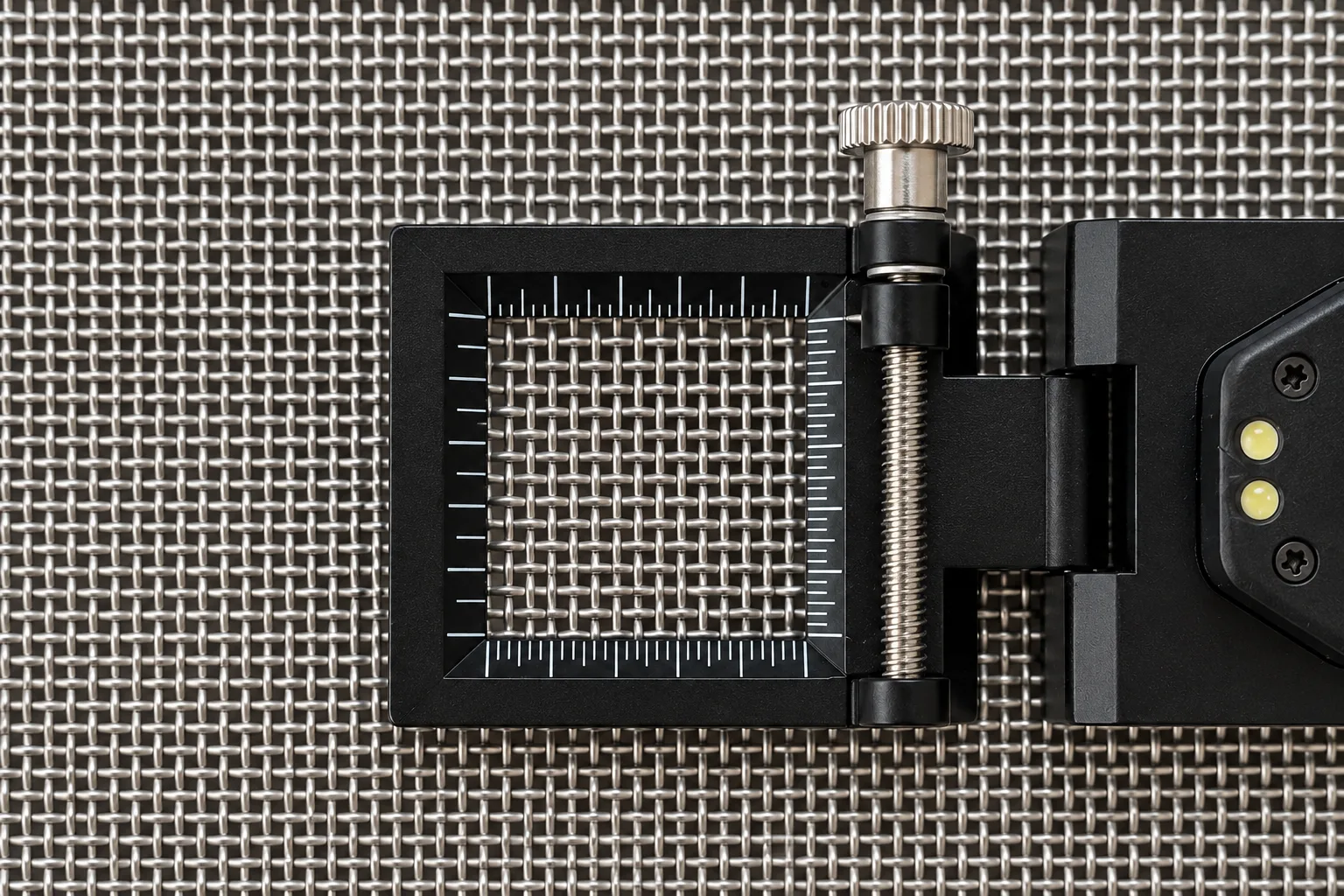
Specifications such as 20 mesh, 40 mesh or 100 mesh describe a count, not a fixed opening size. For square woven mesh, you also need the wire diameter to calculate the nominal aperture.
01 / Understand the count
What is mesh count?
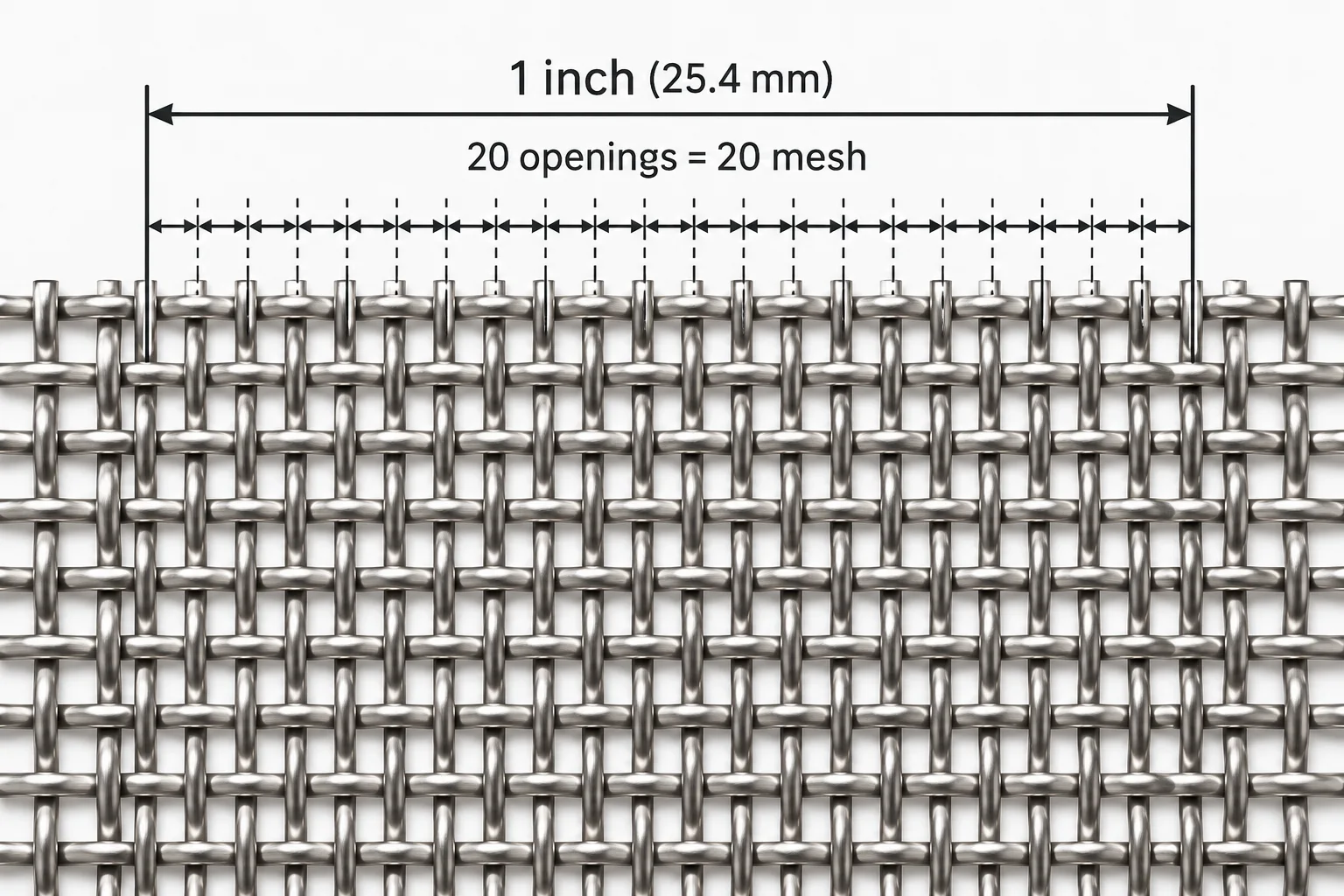
Mesh count is the number of openings per linear inch (25.4 mm). A 20 mesh square weave has approximately 20 openings along one inch; 40 mesh has approximately 40. A higher count usually means smaller openings, but two 20 mesh fabrics can have different openings when their wire diameters differ.
02 / Measure mesh count
Count openings with the right tool
Place a counting glass or mesh counting magnifier flat on the fabric. Align its calibrated scale with one wire direction, then count openings over one inch.
For coarse mesh, mark 25.4 mm on a ruler and count openings within that span. This is a quick field check, not a substitute for calibrated inspection on fine mesh.
Use a measuring microscope or digital inspection microscope when individual openings are too small to count reliably with a ruler.
Count in both wire directions when the specification calls for a square weave. Record any difference rather than assuming both directions are identical.
03 / Check the wire
Measure wire diameter
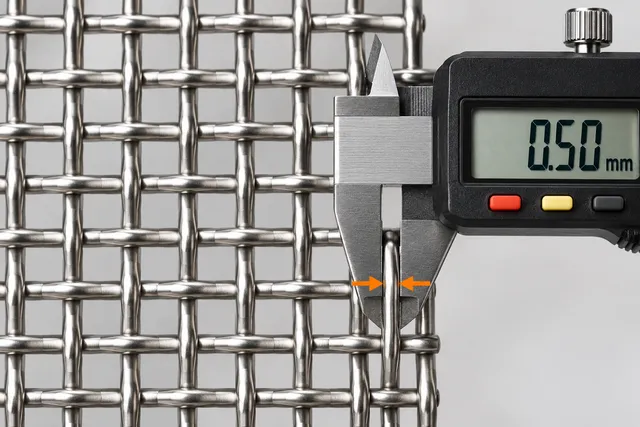
Wire diameter is the thickness of an individual wire. It affects the clear opening, mesh weight, strength and price. Use a micrometer on a suitable exposed wire and take readings at several positions. For very fine wire, a measuring microscope may be more practical than a basic caliper.
04 / Calculate the aperture
Calculate opening size
For a regular square woven mesh, the nominal clear opening can be estimated from the count and wire diameter:
- Wire pitch: 25.4 ÷ 20 = 1.27 mm
- Clear opening: 1.27 − 0.40 = 0.87 mm
This is a nominal geometric value. Actual dimensions can vary with wire tolerance and weaving. The formula is for regular square openings; Dutch weave filtration ratings need product-specific data.
05 / Read specifications
How to read stainless steel wire mesh specifications
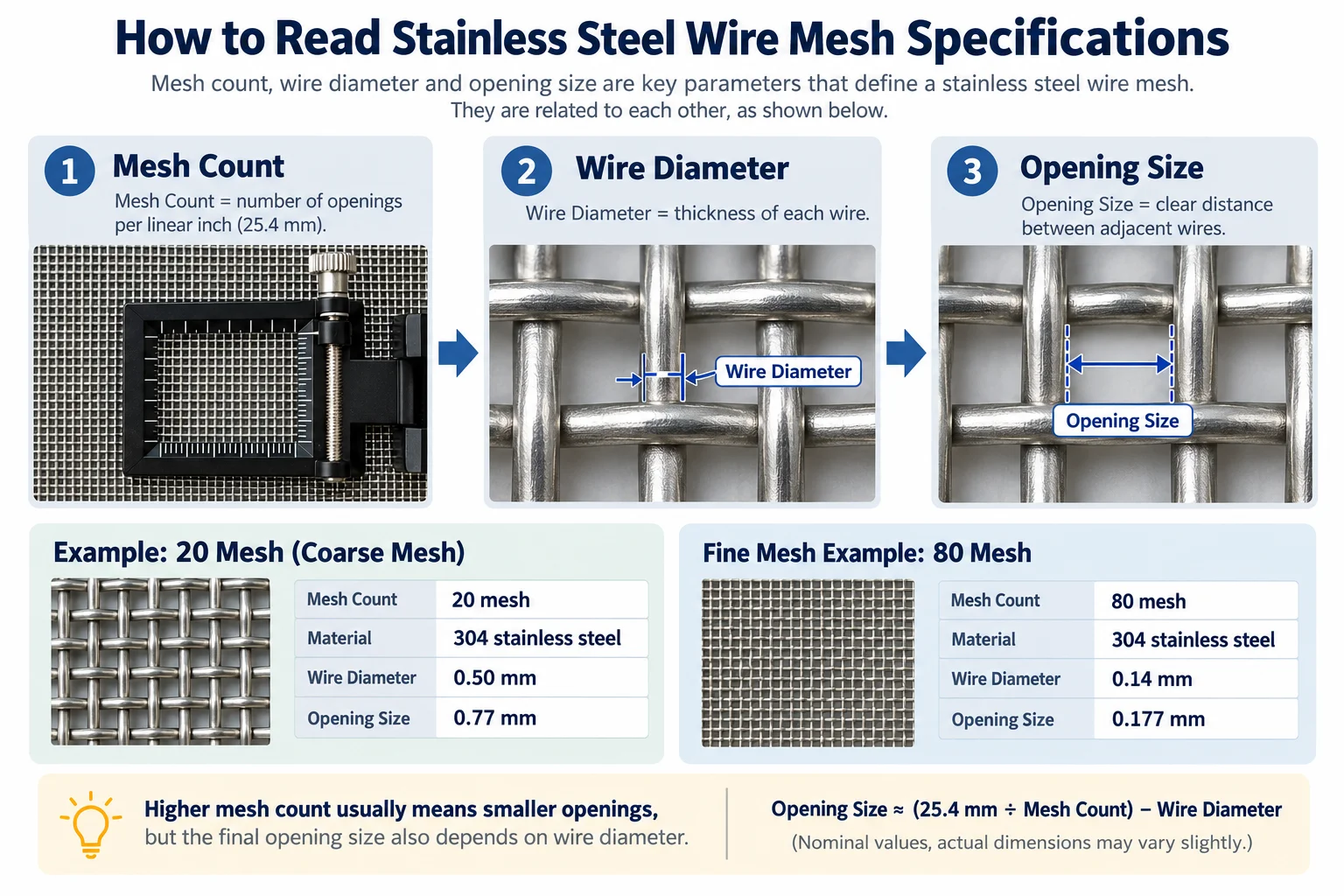
Wire mesh is usually specified as mesh count × wire diameter × opening size. The visual guide compares a 20 mesh sample with a finer 80 mesh sample; check each value against the requested material and weave.
Need a different combination? Calculate nominal opening size →
06 / Prepare the inquiry
What to specify before ordering
Include the measurements and use case so the supplier can check fit and prepare an accurate quotation.
- Material grade
- SS304, SS304L, SS316 or SS316L
- Mesh count
- For example, 20 openings per inch
- Wire diameter
- For example, 0.40 mm
- Opening size
- For example, approximately 0.87 mm
- Roll size
- Width and length, such as 1 m × 30 m
- Quantity
- Rolls, square meters or required weight
- Application
- Filtration, screening, sieving or protection
07 / Inspect the roll
A practical inspection checklist
When checking a received woven wire mesh roll, record the mesh count, wire diameter and opening size, then check the material documentation, roll width and length, weave consistency and surface condition. For fine filtration mesh, confirm the required opening or tested retention rather than relying on mesh count alone.
Mesh and micron are different measurements: mesh counts openings per inch; micron (µm) measures length. There is no universal mesh-to-micron conversion without wire diameter and weave information. Read the mesh count vs micron guide.
Need specification support?
Send us your wire mesh requirements
Share the grade, mesh count or target opening, wire diameter, roll size, quantity and application. If you have a sample, include photos and any measurements you have.