
Expanded metal tool
Expanded Metal Weight & Open Area Calculator
Compare mesh specifications, estimate sheet weight and open area, and plan your next inquiry.
Enter dimensions in millimeters.
Enter dimensions in millimeters to estimate sheet weight and open area.
Calculation results
Estimated sheet weight
18.840 kg(per sheet)Weight per m²
9.420 kg/m²Open area
59.50 %- Sheet area
- 2.00 m²
- Solid area ratio
- 40.50 %
- Material density
- 7.85 g/cm³
These are estimates for comparison and planning. Confirm finished weight and open area for your chosen mesh.
Specification reference
Use the expanded metal measurement guide to check pitch and thickness inputs. Compare mesh opening specifications and finished sheet dimensions before preparing your inquiry.
Key dimensions used in the calculation (all in mm).
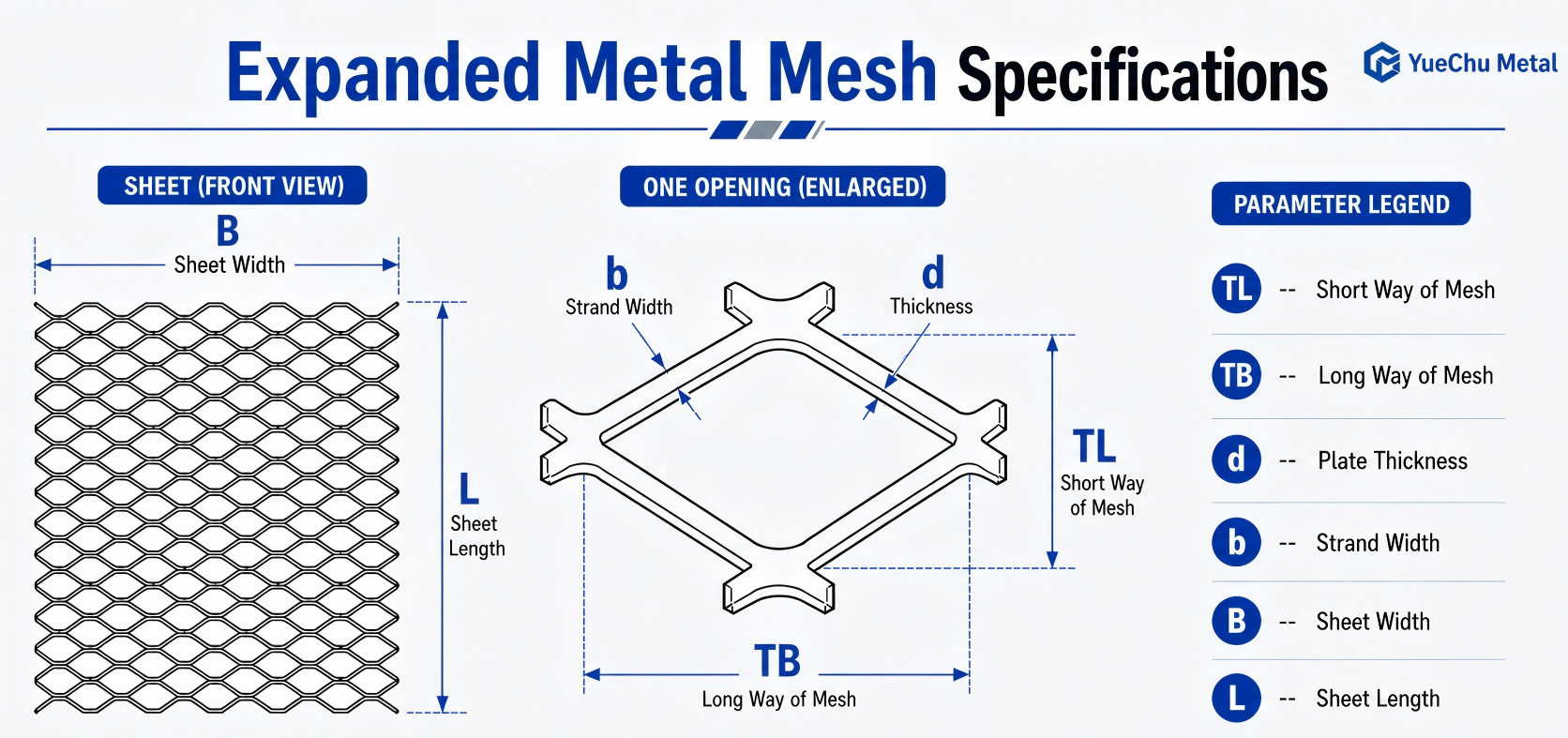
Calculation formula
Dimensions: millimeters. Density: g/cm³. Sheet area: m².
Weight per m²
W = 2 × t × w × ρ / SWD
- t = sheet thickness (mm)
- w = strand width (mm)
- ρ = material density (g/cm³)
- SWD = short pitch (mm)
Open area (%)
A = (1 − w / LWD) × (1 − w / SWD) × 100
- w = strand width (mm)
- LWD = long pitch (mm)
- SWD = short pitch (mm)
Total sheet weight
T = W × Sheet area
- W = weight per m² (kg/m²)
- Sheet area = width × length (m²)
Worked examples & estimate limits
These hypothetical examples demonstrate the formulas above. They are not stock specifications, measured weights or product test results. All dimensions are in mm; density is in g/cm³.
| Material / density | t / w | LWD / SWD | Sheet W × L | kg/m² | kg/sheet | Open area |
|---|---|---|---|---|---|---|
| Steel 7.85 | 2 / 3 | 20 / 10 | 1000 × 2000 | 9.420 | 18.840 | 59.50% |
| Aluminum 2.71 | 1 / 2 | 30 / 15 | 1000 × 2000 | 0.723 | 1.445 | 80.89% |
| Stainless steel 7.93 | 1.5 / 2 | 40 / 20 | 500 × 1000 | 2.379 | 1.190 | 85.50% |
Steel example: 2 × 2 × 3 × 7.85 / 10 = 9.420 kg/m². A 1000 × 2000 mm sheet has an area of 2 m², giving 18.840 kg. Estimated open area is (1 − 3/20) × (1 − 3/10) × 100 = 59.50%.
Conditions for using these estimates
- Enter bond-center pitches, base metal thickness and strand width at agreed measurement points. Do not use clear openings or overall raised mesh height in their place.
- Density values are nominal. The formulas approximate uniform geometry and exclude coatings, frames, fixings and accessories; bond shape, flattening and cut edges can affect the result.
- Open area is a geometric estimate, not a certified airflow, filtration or load rating. Confirm it for the finished mesh and viewing or flow direction.
Compare an estimate with a measured sample
Use the same identified panel and record its alloy, profile, finish, dimensions, measurement method, scale resolution and date. Weigh the mesh separately from packaging and attachments. Report measured kg/m² as measured mass ÷ measured sheet area, and the mass difference as (measured − estimated) ÷ estimated × 100%. Agree acceptance limits for the actual product; a worked example does not establish a tolerance.
Expanded Metal Calculator FAQFAQ
Which dimensions do I need?
Enter base sheet thickness, strand width, LWD, SWD and the finished sheet width and length. Use millimeters for every dimension.
Are LWD and SWD the clear opening sizes?
No. Enter the diamond pitch between corresponding bond centers. A clear opening is the free space between strands and must not be substituted for pitch.
Can I compare raised and flattened mesh?
Use the tool as an initial estimate for either profile. Enter base metal thickness rather than overall raised mesh height; confirm finished dimensions and mass for the selected product.
How do I calculate stainless steel expanded metal weight?
Select Stainless steel. The calculator uses a nominal density of 7.93 g/cm³. For a specific alloy or a certified order, use supplier-confirmed mass data.
Why can the delivered weight differ?
Material grade, strand geometry, flattening, tolerances, coatings and cut edges affect finished mesh. This estimate excludes added frames and accessories.
What should I send with a quotation request?
Include the material grade, mesh profile, thickness, strand width, pitches, sheet dimensions, quantity and finish. A drawing or sample photo helps confirm the pattern.
Have a pattern or drawing ready?
Send the dimensions, material and quantity to confirm a suitable expanded metal specification.