
Expanded metal measurement guide
How to Measure Expanded Metal Mesh
Measure diamond pitches, clear openings, strand width, metal thickness and sheet size. Keep the measurement references consistent so your drawing, quotation and finished mesh describe the same product.
01 / Identify the dimensions
Expanded Metal Measurement Diagram
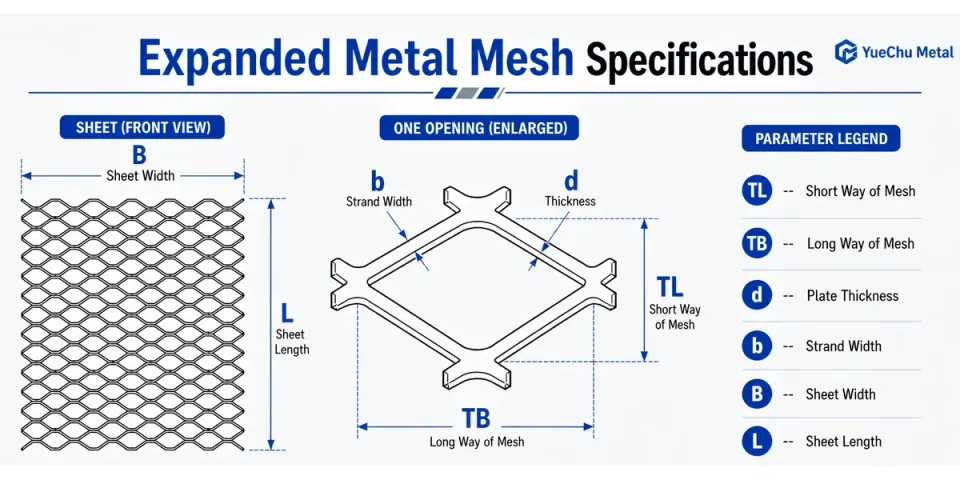
02 / Use the right reference points
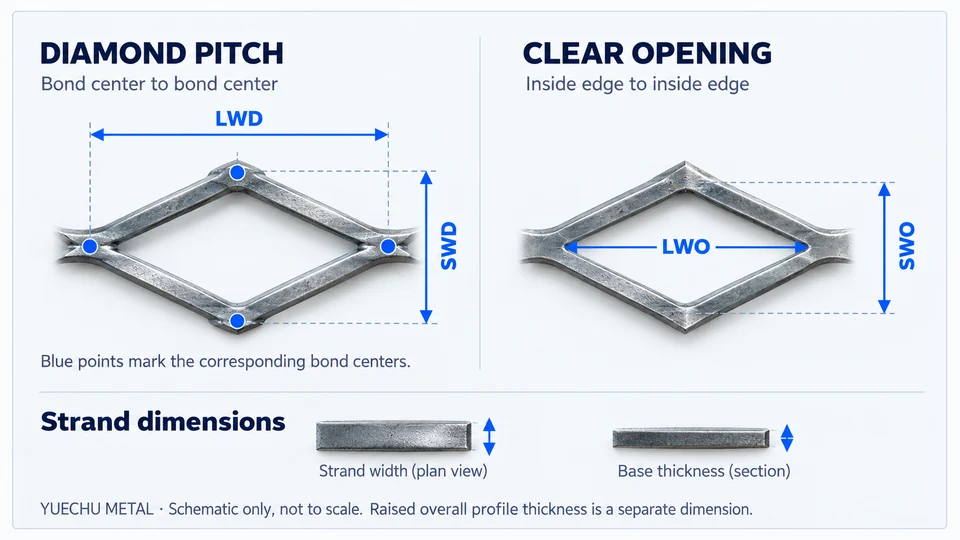
SWD & LWD Pitch vs. SWO & LWO Clear Opening
Pitch and clear opening are different measurements. In this guide and our expanded metal calculator, SWD and LWD mean bond-center pitches. SWO and LWO mean the unobstructed inside opening. State both when the opening clearance is critical.
- SWD / LWD
- Corresponding bond center to bond center, across the short / long diamond direction.
- SWO / LWO
- Inside edge to inside edge of the opening, across the short / long direction.
03 / Measure the sample
How to Measure Expanded Metal Step by Step
Identify whether the sample is raised expanded metal or flattened expanded metal before recording thickness and finished geometry.
Use a suitable ruler, caliper or micrometer with a checked scale. Avoid damaged edges and agree on the measurement method and tolerances before inspection.
Measure the short-way pitch (SWD)
Place the sample flat without stretching it. Measure from the center of one bond to the corresponding bond center across the short direction of the diamond. Where practical, measure several complete repeats and divide by the number of repeats. Record the result in millimeters.
Measure the long-way pitch (LWD)
Repeat the bond-center measurement along the long direction of the diamond. Use the same reference points for each repeat, and mark the SWD and LWD directions on the drawing or sample photo.
Check the clear openings (SWO and LWO)
Measure the unobstructed space between the inside edges of the strands in each direction. Record these values separately from the pitches, especially for screening, guarding or a clearance requirement. State whether the measurement is before or after coating.
Measure strand width and metal thickness
Measure strand width across an individual strand, perpendicular to its length, away from the wider bond. Check the metal thickness on a suitable strand location. For raised mesh, record overall profile thickness separately; it is not the same as base metal thickness. Confirm whether a thickness requirement refers to the starting sheet or the finished mesh.
Record sheet size, orientation and finish
Measure the overall panel width and length, and identify which diamond direction runs along each side. State raised or flattened, the material grade, finish, edge condition and required tolerances. Check several representative positions and record the range rather than relying on one reading.
Calculate weight and open area after measuring
Enter bond-center pitches, strand dimensions, material and sheet size in the expanded metal calculator. Its results are theoretical estimates; they do not certify measured weight, opening clearance or service performance.
04 / Prepare the specification
Expanded Metal Specification Checklist
| Item | What to confirm |
|---|---|
| Material and grade | Carbon steel, galvanized steel, aluminum, stainless steel, copper, titanium or the specified alloy. |
| Surface profile | Raised / standard or flattened; identify the finished condition. |
| SWD × LWD | Short-way and long-way bond-center pitches, in mm. |
| SWO × LWO | Short-way and long-way clear openings, where required; keep separate from pitch. |
| Strand width | Width across one strand, away from the bond, in mm. |
| Metal thickness | State starting-sheet or finished-strand thickness; list raised overall thickness separately. |
| Sheet dimensions | Overall width × length, with diamond direction, cut edges and tolerances. |
| Surface finish | Mill finish, galvanized, anodized, powder coated or another agreed treatment. |
| Order details | Quantity, application, drawing or sample reference, and delivery destination. |
For full sheets and cut panels, see the sheet size, edge and tolerance guide. For pattern selection, compare expanded metal mesh openings and open area.
05 / Check before sending
Common Measurement Mistakes to Avoid
- Using an inside opening measurement as the bond-center pitch.
- Mixing raised overall profile thickness with the thickness of the metal itself.
- Leaving out the raised or flattened profile, material grade or coating condition.
- Sending only two diamond dimensions without strand width, thickness or sheet size.
- Omitting diamond orientation, cut-edge requirements or the agreed inspection tolerances.
06 / Measurement questions
Expanded Metal Measurement FAQ
What is SWD in expanded metal mesh?
SWD means Short Way of Diamond. This guide and our calculator use it for the short-direction bond-center pitch. The short-direction clear opening is SWO. Label the reference points on your drawing because supplier notation can vary.
What is LWD in expanded metal mesh?
LWD means Long Way of Diamond. Here it is the long-direction bond-center pitch. Record the long-direction clear opening separately as LWO, and identify the diamond orientation on the finished sheet.
How should thickness be specified for raised or flattened mesh?
State the surface profile and whether the required metal thickness refers to the starting sheet or the finished strand. For raised mesh, specify overall profile thickness separately. Flattening can change the finished strand dimensions, so confirm the inspection condition with the supplier.
What should I send for an accurate quotation?
Send material and grade, raised or flattened profile, SWD and LWD pitches, any required clear openings, strand width, metal thickness, panel width and length, diamond direction, finish, quantity and delivery destination. Include a marked drawing or sample photo when available.
Need specification support?
Send Your Drawing or Sample Measurements
Share the material, profile, labeled dimensions, quantity and application. Include a drawing or clear sample photos so the measurement references can be checked before quotation.
Request a quotation